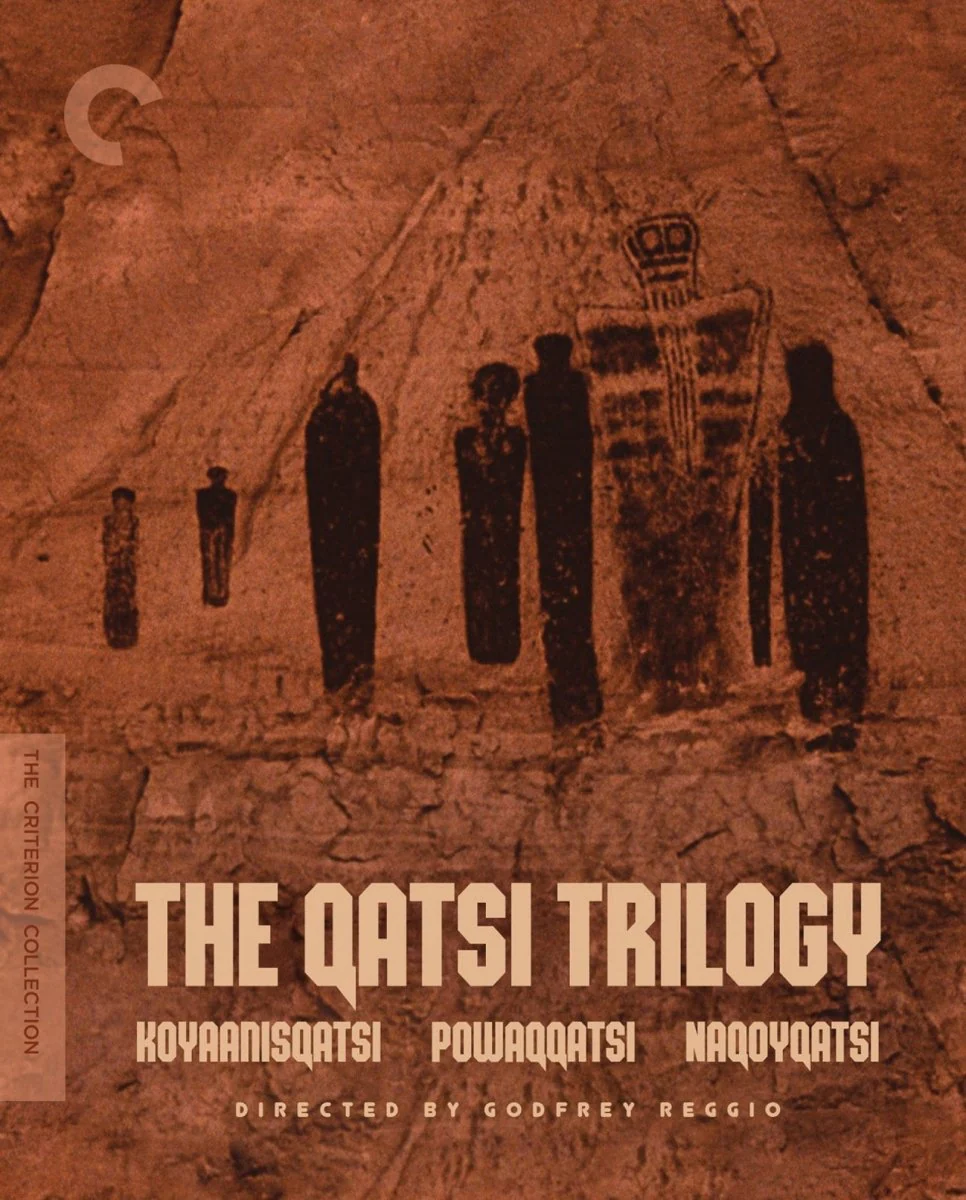
A singular artist and activist, Godfrey Reggio is best known for the galvanizing films of The Qatsi Trilogy. Astonishingly photographed, and featuring unforgettable, cascading scores by Philip Glass, these are immersive sensory experiences that meditate on the havoc humankind’s obsession with technological advancement has wreaked on our world. From 1983’s Koyaanisqatsi to 1988’s Powaqqatsi to 2002’s Naqoyqatsi, Reggio takes us on a journey from the ancient to the contemporary, from nature to industry, exploring life out of balance, in transformation, and as war, all the while keeping our eyes wide with wonder.


Koyaanisqatsi
1983
An unconventional work in every way, Godfrey Reggio’s Koyaanisqatsi was nevertheless a sensation when it was released in 1983. This first work of The Qatsi Trilogy wordlessly surveys the rapidly changing environments of the Northern Hemisphere, in an astonishing collage created by the director, cinematographer Ron Fricke, and composer Philip Glass. It shuttles viewers from one jaw-dropping vision to the next, moving from images of untouched nature to others depicting human beings’ increasing dependence on technology Koyaanisqatsi’s heterodox methods (including hypnotic time-lapse photography) make it a look at our world from a truly unique angle.

Powaqqatsi
1988
Five years after Godfrey Reggio stunned audiences with Koyaanisqatsi, he again joined forces with composer Philip Glass and other collaborators for a second chapter. Here, Reggio turns his sights on third-world nations in the Southern Hemisphere. Forgoing the sped-up aesthetic of the first film, Powaqqatsi employs a meditative slow motion in order to reveal the beauty of the traditional ways of life in those parts of the planet, and to show how cultures there are being eroded as their environments are taken over by industry. This is the most intensely spiritual segment of Reggio’s philosophical and visually remarkable Qatsi Trilogy.

Naqoyqatsi
2002
Godfrey Reggio takes on the digital revolution in the final chapter of his Qatsi Trilogy. Through a variety of cinematic techniques, including slow motion, time-lapse, computer- generated imagery, and found footage, the film tells of a world that has completed the transition from the natural to the artificial. Globalization has been accomplished, all of our interactions are technologically mediated, and all images are manipulated. From this (virtual) reality, Reggio sculpts a frenetic yet ruminative portrait of an era in which the cacophony of “communication” has rendered humankind effectively postlanguage.
- New, restored digital transfers of all three films, approved by director Godfrey Reggio, with 5.1 DTS-HD Master Audio soundtracks on the Blu-ray edition
-
Essence of Life, an interview program with Reggio and composer Philip Glass on Koyaanisqatsi
- New interview with cinematographer Ron Fricke about Koyaanisqatsi
- Television spots and a new interview with Reggio relating to his 1970s multimedia privacy campaign in New Mexico
- Early forty-minute demo version of Koyaanisqatsi with a partial scratch soundtrack featuring poet Allen Ginsberg, along with a new introduction by Reggio
- New interview with Reggio about Koyaanisqatsi’s original visual concept, with behind-the-scenes footage
-
Impact of Progress, an interview program with Reggio and Glass on their collaboration
-
Inspiration and Ideas, a new interview with Reggio about his greatest influences and teachers
- Public television interview with Reggio from 1989 about the trilogy
-
Anima Mundi (1992), Reggio’s twenty-eight-minute montage of footage of over seventy animal species, scored by Glass
- New video afterword by Reggio on the trilogy
-
The Making of “Naqoyqatsi,” a brief documentary featuring interviews with the production crew
- Panel discussion on Naqoyqatsi from 2003, with Reggio, Glass, editor Jon Kane, and music critic John Rockwell
- Interview with Glass and cellist Yo-Yo Ma
- Trailers
- PLUS: A booklet featuring new essays by film scholar Scott MacDonald, Rockwell, and author and environmentalist Bill McKibben